Dance-researcher | Maker | Educator
Dance-researcher | Maker | Educator
Dance-researcher | Maker | Educator
Dance-researcher | Maker | Educator
Sylvia holds a Master’s Degree in Dance-Teaching and a Specialist title in Dance from the Lisbon Polytechnic Institute, as well as a Bachelor of Fine Arts from The Juilliard School in New York City. She received her vocational training in Dance from the Dutch National Ballet Academy in the Netherlands, Elmhurst Ballet School in the UK, and The Juilliard School in the USA, and was nominated as Outstanding Young Dancer by dance critic Lilo Weber during her time as a professional dancer with the Stadttheater Bern Ballet in Switzerland.
From 1996 to 2019, Sylvia danced professionally in small and large repertoire dance companies, and independent projects in the Netherlands, Germany, Switzerland, and Portugal, working directly and indirectly with choreographers such as Roberto Galván at Stadttheater Giessen; Orjan Andersson, Stijn Célis, Félix Duméril, Nils Christe, Jacopo Godani, António Gomes, Foofwa d'Immobilité, Jiří Kylián, Denise Lampart, David Parsons, Gisela Rocha, Philippe Saire, and Pierre Wyss at Stadttheater Bern Ballet; Ivan Wolfe and Frey Faust at Pool Dance Company; Philipp Egli at Dance Company Molteni; Massimo Bertinelli, Beatrice Jaccard, Sylvia Rijmer, Peter Schelling, and Ivan Wolfe at Cie. DRIFT; and Clara Andermatt, Mauro Bigonzetti, Stijn Célis, Marie Chouinard, Rui Lopes Graça, Rui Horta, Gilles Jobin, Jiří Kylián, Ohad Naharin, Paulo Ribeiro, Hervé Robbe, and Didy Veldman at Ballet Gulbenkian, Olga Roriz at Companhia Olga Roriz and André Mesquita, to name a few.
As an independent dance-maker, she created group and solo works for the Stadttheater Bern Ballet Young Choreographers (CH), École des Sables (SN), NRW Tanzhaus (DE), Matadero (ES), and Quorum Project (PT). She especially enjoys choreographic collaborations, having created with dance artists such as Allan Falieri, André Mesquita, Marco da Silva Ferreira, Teresa Alves da Silva, and Iratxe Ansa, to mention a few.
As a répétiteur and choreographic assistant from 2010 to 2014, she worked closely with Portuguese choreographer Olga Roriz, building and setting three original works for the Companhia de Dança Olga Roriz, the Companhia Nacional de Bailado in Portugal, and Teatro Guaíra in Brazil. Sylvia has taught extensively in various dance institutions and dance companies, such as Teatro Guaíra, Estúdios Vítor Cordón, Quorum Ballet, O Espaço do Tempo (Rui Horta), Companhia de Dança Olga Roriz, Companhia Nacional de Bailado, École des Sables, and the Companhia Portuguesa de Bailado Contemporânea (CPBC), varying her teaching from contemporary ballet to contemporary dance and choreographic creation.
As a dance researcher, Sylvia is interested in the intersection between the performing arts and science, having collaborated as a guest choreographer on several interdisciplinary and multimodal research projects bridging contemporary dance, psycholinguistics, choreographic composition, technology, and artificial intelligence to investigate alternative practices for making and thinking about dance. These projects included: BlackBox Arts & Cognition, based at the School of Social Sciences and Humanities at NOVA University Lisbon (2018–2023), where her research was framed around attention and habitual movement patterns in dance-making; the Moving Digits project (2019–2020), which aimed to enhance audience understanding and engagement in contemporary dance performances, where her research focused on the digital glitch and the error; the Choreographic Coding Lab (2023), aimed at creative coding in contemporary dance practices, where she looked into AI as a tool for alternative dance-making; and Bodily Futures: Dance and AI (2023–2026), a project in collaboration with five contemporary dancers, cognitive linguist Vito Evola (NOVA University Lisbon, School of Social Sciences and Humanities), and computer researcher Cláudia Sevivas (IADE University), funded by the IDI&CA 2023 program of the Lisbon Polytechnic Institute.
As an invited dance researcher, she has shared her interdisciplinary and multimodal research in dance and technology at various research laboratories, institutions, conferences, and festivals. These include the LASEEB Lab at the Institute for Systems and Robotics (ISR-Lisboa) – Instituto Superior Técnico, University of Lisbon; the SOBA Lab (The Social Brain in Action Lab) at the University of Glasgow; DDCMC19 (The Dance, Data and Multimodal Communication Conference) at the School of Social Sciences and Humanities, NOVA University Lisbon; the Hidden Layers: AI and Design Conference at the Köln International School of Design (DE); the LARSyS (Laboratory for Robotics and Engineering Systems) 2024 Annual Meeting (PT); the MATE Festival (Music, Art, Technology and Education) 2024 (PT); the Pedra Dura Festival 2024 (PT); and most recently SALC10 (The 10th Conference of the Scandinavian Association for Language and Cognition) 2026 at Umeå University (SE).
In the realm of dance on film, she created The Phoenix reborn from its ashes in collaboration with filmmaker Abass Abass, with the support of the José Saramago Foundation, the Camões Institute, the Portuguese Embassy in Dakar, and the Lisbon Polytechnic Institute. She also co-created Dance in Virtual Reality Installation, a VR installation developed by the BlackBox team alongside Sylvia Rijmer and three contemporary dancers to document the research around her original Body Logic Method (BLM) using Kinect, 3D point clouds, stereoscopic images, and audio-video technology. Additionally, she created Bodily Futures: Dance and AI in collaboration with filmmaker Pedro Rodrigues at IADE Faculty of Design, Technology and Communication (PT) and film editor Margarida Borges Martins, which is scheduled for release in August 2026.
Sylvia is a full-time dance professor at the Escola Superior de Dança in Lisbon, where she teaches in the Bachelor’s Degree in Dance program and supervises students in the Master’s programs in Dance Teaching.

Image "Nostos" by André Mesquita and dancers. Photo: Guzmán Rosado

A dance for 16 graduating dance students of the Superior School of Dance, Polytechnic Institute of Lisbon.
When contemporary dancers move, thought becomes visible. Every gesture is a decision, every phrase a living pattern shaped by embodied knowledge, motor intelligence, and imagination. Movement reveals the brain at work, activating memory, perception, and motor imagery in a continuous dialogue between body and mind.
Choreography & Concept: Sylvia Rijmer
In collaboration with Dancers: Bruna Miranda, Carolina Pica, Catarina Dias, Inês Rodrigues, Ìsis Zarcos, Joana Teixeira, Lara Sanchéz, Mafalda Tavares, Maria Pereira, Mariana Mendes, Marta Nunes, Nelma Santos, Patrícia Duarte, Paulo Diego, Ricardo Esteves, David Pinto
Music by: Ensemble Alorna
Musicians: Tera Shimizu (Artistic Direction/Violin Solo 1), Zachary Spontak (Violin Solo 2), Maria José Laginha (Violin 1), Bernardo Barreira (Violin 2), Nuno Soares (Viola), Martin Henneken (Cello)
Makeup/Hair: Nelma Santos
Performed at: TIC - Técnico Innovation Center (Powered by Fidelidade), Lisbon ; Criarte - Carcavelos, Lisbon
Image: Superior School of Dance/Catarina Dias and Ricardo Esteves.
Lisbon, 2026
A creation for 11 dancers of the Quorum Project
Quorum Ballet Portugal
This dance is inspired by the wisdom of the crowd according to James Surowiecki and focuses on collective intelligence as a means to highlight the dynamic role of the precious individual within it. Constructed mainly as a group work, it hopes to bring to the forefront the subtle differences of each dancer whose uniquely inherited dance patterns and movement habits exhibit diverse journeys and backgrounds in dance. This work is a collective of individuals.
.
Choreography & Concept: Sylvia Rijmer
In collaboration with Dancers: Filomena Melim, Inês Ribeiro, Leonor Paulo, Margarida Santos, Mariana Simões, Matilde Pinto, Margarida Santos, Carolina Cruz, Catarina Jesus, Íris Santos, Laura Santos.
Music: Miguel Lucas Mendes, Johann Sebastian Bach
Choreographic Assistance: Kenji Matsuyama.-Ribeiro, Kim Pothoff
Lisbon, 2024
A dance for the graduating dance students at the Superior School of Dance, Polytechnic Institute of Lisbon
As a contemporary dancer in a dance-making process, one is often asked to co-create in real-time. Through choreographic or compositional tasks and other forms of motivational input, the choreographer seeks movement material from the dancers from which to dialogue. In such processes of collaborative creations, the dancer is often confronted with their creative limitations and habitual movement patterns: physical, stylistic, and /or methodological.
This work is the result of various cognitively induced, task-based improvisations and compositions, with the intuitive to physically and mentally explore the choreographic diversity of the students eager to share their own creative universes and physical convictions. Like a chrysalis waiting to be borne, what becomes visible is the invisible.
Choreography & Concept: Sylvia Rijmer
In collaboration with Dancers: Andreia Brasil, Ariana Mira, Carolina Vouga, Clotilde Vaida, Daniel Pirata, Denise Almeida, Emma-Liina Naumanen, Filipa Pereira, Francisca Coelho, Frederico Machado, Hilja Tapio, Inês Arrenegado, Inês Gil, Isabela Costa, Joana Rosado, Kata Kiss, Leonor Mateus, Leonor Sequeira, Lilian Mester, Margarida Coelho, Panna Pozsony, Rodrigo C. Pereira, Aleksandra Demina e Zsófia Matesz
Music: Miguel Lucas Mendes, Johann Sebastian Bach
Lisbon, 2023
Image of dance-artists of the Jant-Bi Dance Company at the
beach in Toubab Dialao,
Choreography & Concept: Sylvia Rijmer
In collaboration with Dance-Artists: Adama Gnom, Ana rita Almeida, Baye Ibrahima Diagne, Birame Faye, Dieynaba Ndoye, Ibrahima Faye, Khady Ba, Mamadou Diallo, Marie Faye, Ousmane Cissé Diane, Serigne Fallou Séne
Photographer: Abass Abass
Toubab Dialao, Senegal, 2022
A dance for the 2nd year students at the Superior School of Dance, Polytechnic Institute of Lisbon
A creation inspired by Steve Reich's "Clapping Music" and Social Media. Made during Social Distancing.
Choreography & Concept: Sylvia Rijmer
In collaboration with Dancers: Alice Machado, Ana Rita Almeida, Beatriz Silva, Catarina Nunes, Filomena Melim, Francisco Fereire, Gabriela Coelho, nês Casaca, Inês Fertuzinhos, Joana Marques, Laura Barreta, Maria Viegas, Maria Estela dos Santos, Mariana Tiago, Mariana Vasconcelos, Rodrigo Pereita, Sara Carvalho
Original Text: Diogo Bento
Dramaturgy: Sylvia Rijmer & Diogo Bento
Music: Miguel Lucas Mendes
Lisbon, 2021
A dance and technology research-performance inspired by the glitch - as concept and induced creative error.
Created within the project Moving Digits: Augmented Dance for Engaged Audience.
Link: A Beautiful Glitch
Choreography & Concept: Sylvia Rijmer
In collaboration with Dancers:
Hanna Junti, Liis Vares (Tallinn, Aug/19)
and
Maria Pyatkova, Teresa Alves da Silva (Düsseldorf, Oct/19)
Visuals, Sound and Interaction: Stephan Jürgens, Raul Masu and Jochen Feitsch
Additional input:William Primett
NRW Tanzhaus
Düsseldorf, 2019
This short is inspired by the glitch - as concept and induced creative error. The moving image was generated using human dance data collected in Captury Motion Capture
Concept and Digital Choreography: Sylvia Rijmer
In collaboration with Dancers:
Hanna Junti, Liis Vares (Tallinn, Aug/19)
Music: Miguel Lucas Mendes
Researched and constructed within Moving Digits: Augmented Dance for Engaged Audience Project no. 597398-CREA-1-2018-1-PT-CULT-COOP1, co-funded by Creative Europe – Culture Sub-programme, 2018 – Education, Audiovisual and Culture Executive Agency (EACEA) of the European Union.
Tallin, 2019
A gathering of 3 contemporary dancers and 4 classical musicians, inspired by real-time visceral collaboration, cooperationn and reciprocity.
Choreography & Concept: Sylvia Rijmer
In collaboration with Dancers: Inês Pedrucco, André Campos, Bruno Alves
Alorna Ensemble: Tera Shimizu (violin), Maria José Laginha (violin), Augusta(viola), Martin Henneken (cello)
Creative Advisor: Paulo Reis
Film & Editing: Luís Marrafa
CAL - Centro de Artes em Lisboa
Lisbon, 2018
A dance based on the tension between inner states of conflict
and public scrutiny.
Choreograpy & Concept: Sylvia Rijmer
In collaboration with Dancers: Teresa Alves da Silva, André Mesquita
Dancers: Teresa Alves da Silva, Sylvia Rijmer, André Mesquita
Live Music & Original Composition: Miguel Lucas Mendes
Light Design: Nuno Salsinha, Tela Negra.
Texts: Ray Bradbury, Sylvia Rijmer
Dramaturgy: Paulo Reis
Photography: Guzmán Rosado
Video editing: Guzmán Rosado
Co-production: Tok'Art
Support: Company Olga Roriz, Teatro Extremo, Pro Dança
Centro Cultural de Cartaxo
Cartaxo, 2017
All visible, bio-mechanical motion begins somewhere within the body.
This performance wishes to show the visual dissection of bio-mechanical motion, highlighting the birth of a relatively simple movement - like a bend in the wrist, to a complex execution of a dance phrase - as a choreography.
Choreography and Concept: Sylvia Rijmer
In collaboration with Dancer/Performer: Marco da Silva Ferreira
Concept & Original Music: Miguel Lucas Mendes
Light Design: Nuno Salsinha / Tela Negra, Lda
Light Operator: Margarida Moreira
Photography & Morphing Film: Hugo Alves
Production: Tânia Guerreiro / Produções Independentes
BlackBox, Centro Cultural de Belém
Lisbon, 2012
A choreographic work based on various choreographic proposals by the dancers/performers and their means of communication through human and artistic movement.
Co-Choreography and Interpretation: Iratxe Ansa, Igor Bacovich, Allan Falieri, Chevy Muradai, Sylvia Rijmer, Daan Vervoort
Musicians: Miguel Lucas Mendes, Daniel del Rio, Artur Vida
MATADERO MADRID: Centro de Creación Contemporánea
Madrid, 2010

Sylvia currently teaches in the Bachelor of Dance program and supervises a select series of students within the Master's Degree in Dance Teaching program.
A physical performance workshop celebrating diversity, eclectic human creativity & artistic singularity within a safe studio space.
direction: Allan Falieiri & Sylvia Rijmer
Singularity I Workshop
guided by Allan Falieri & Sylvia Rijmer
& special guest Fabiana Nunes -dramaturgical director and rehearsal coordinator of the Ballet Company of th
A physical performance workshop celebrating diversity, eclectic human creativity & artistic singularity within a safe studio space.
direction: Allan Falieiri & Sylvia Rijmer
Singularity I Workshop
guided by Allan Falieri & Sylvia Rijmer
& special guest Fabiana Nunes -dramaturgical director and rehearsal coordinator of the Ballet Company of the City of Niterói (CBCN).
Singularity II Workshop
t.b.a soon!
Companhia Portuguesa de Bailado Contemporânea (CPBC)Arabesque Dance Academy, Estúdios Vitor Cordón, Companhia Olga Roriz, Companhia Nacional de Bailado, Teatro Guaíra, Conservatório do Coimbra, Stageworks Rui Horta, Quorum Ballet, Mastumoto Performing Arts Center, Forum Dança, Density96
Guest choreographer/researcher
Personal Research Theme: Using invented and re- processed improvisational tools to find a body logic within a performative platform which makes sense to both dancer and spectator, introducing the negotiation of choice as an active and practical tool within dance making, teaching and thinking.
© 2014–2019 B
Guest choreographer/researcher
Personal Research Theme: Using invented and re- processed improvisational tools to find a body logic within a performative platform which makes sense to both dancer and spectator, introducing the negotiation of choice as an active and practical tool within dance making, teaching and thinking.
© 2014–2019 BlackBox - Arts & Cognition | Legal Info | Privacy Policy | DfH
Guest choreographer/researcher
Personal Research Theme: Capturing the digital glitch using motion capture in contemporary dance-making.
Project no. 597398-CREA-1-2018-1-PT-CULT-COOP1, co-funded by Creative Europe – Culture Sub-programme, 2018 – Education, Audiovisual and Culture Executive Agency (EACEA) of the European Union.

Invited choreographer/researcher
Personal Research Theme: Body Logic Method and AI: Alternative modes for making a dance using human-machine interaction
© 2023 Deutsche Sporthochschule Köln

An academic and interactive presentation of the research Bodily Futures: Dance and AI. Invitation by Dr. Patrícia Figuereido - Associate Professor with the Department of Bioengineering at Instituto Superior Técnico (IST), Universidade de Lisboa.
University of Lisbon, PT, 2024

Invitation for a Round Table discussion on current practices in dance. A presentation of the research on Bodily Futures: Dance and AI. Invitation by Fabiana Nunes - dramaturg Ballet Niteroi and Ana Vitória - Post-Doctorate in Performance Arts (Faculty of Human Motricity, University of Lisbon - Portugal) and PhD in Arts - Performances of the Body from the Federal University of the State of Rio de Janeiro (UNIRIO/Brazil). Organised by Faculdade Angel Vianna, Rio de Janeiro.
Penha Sco Cultural Center, Lisbon, PT 2024

An interactive, multimodal dance and technology masterclass of Bodily Futures: Dance and AI.
Participants will explore the Body Logic Method – a task-based composition tool designed to challenge ingrained movement habits – and will physically interact with movement sequences generated by AI in an immersive Virtual Reality environment. The aim is to reconsider the usual decision-making processes in dance and challenge the embodied "body logic" through a new experience that combines technology with artistic expression and composition.
Lagos, PT, 2024

An invitation by Dr. Milena Ivanova - Senior Teaching Associate and Course Director in Philosophy at the the Institute of Continuing Education (ICE) to participate in the discussion group as art-based digital researcher in AI in the event: THE FUTURE OF ART IN THE AI AGE.
Newnham College, Cambridge University, U.K 2024

An academic and interactive presentation of the research on Bodily Futures: Dance and AI. Invitation by Dr. Anna Ciaunica - Research Associate at the Institute of Cognitive Neuroscience, University College London, UK for the Conference on Consciousness and Embodied Selfhood in Biological and Artificial Agents.
Centro de Filosofia das Ciências da Universidade de Lisboa Campo Grande, Lisbon, PT, 2024

An academic and interactive presentation of the research on Bodily Futures: Dance and AI. Presentation in the Technology Section of the Festival.
Convento São Francisco, Coimbra, PT 2024

An academic and performative presentation of the research on Bodily Futures: Dance and AI at the LARSYS annual meeting 2024. Invitation by Dr. Patrícia Figuereido - Associate Professor with the Department of Bioengineering and Dr. José Santos-Victor - Professor ECE, Robotics & Computer Vision at Técnico (IST), University of Lisbon.
Pavilhão de Conhecimento Lisbon, PT, 2024
Guest speaker for the 2nd Congress in artistic specialised teachings.
Title of talk: Teaching dance in the 21st century.
Gulbenkian Foundation, Lisbon, PT, 2022
Guest teaching of a contemporary ballet class for the seminar aimed at dancers, trainers, and advanced students of the Almada Dance Company, with the aim of rethinking the training of the contemporary dancer.
Almada Dance Company, PT,
2020
Invitation by Dr. Emily Cross
Soba Lab: Social Brain in Action
The University of Glasgow: Institute of Psychology and Neuroscience
Title of talk: Negotiating Deliberate Choice-Making in a "New" Contemporary Dance
University of Glasgow,GB-SCT, 2019
Invitation by Dr. Patricia Figuereido
LASEEB: Arts and Science Talk
Técnico, University of Lisbon: Institute for Systems and Robotics
Title of talk: Negotiating Deliberate Choice-Making in a "New" Contemporary Dance
Técnico, University of Lisbon, PT, 2019
Invitation by Dr. Carla Fernandes
DDCMC19 - Dance Data, Cognition and Multimodal Communication
Nova University
Title of talk: Negotiating Deliberate Choice-Making in a "New" Contemporary Dance
Nova University, Lisbon, PT, 2019

A triple bill of classical dance in contemporary motion(s): A brief reflection on the extraordinary
versatility of the classical dance movement canon in constant states of evolution through living
practices.
Cláudia Sevivas, Sylvia Rijmer and Vito Evola "Generative AI, Decision-Making, and Collaborative Choreography: How LSTM Networks Mirror Human Creativity," Rrrreflect. Journal of Integrated Design Research, Special Issue 1 (2024). DOI
Rijmer, S. (2022). Negotiating Deliberate Choice-Making: Insights from an interdisciplinary and multimodal encounter during the making of a New Contemporary Dance. In C. Fernandes, V. Evola, & C. Ribeiro (Eds.), Dance Data, Cognition, and Multimodal Communication (pp. 15-37). Routledge. https://doi.org/10.4324/9781003106401-3
Fonseca, A. R., Abreu, R., & Fernandes, C. (2022). “I see something and I like it”: Unveiling a choreographer’s decision-making process using quantitative and qualitative methods. In C. Fernandes, V. Evola, & C. Ribeiro (Eds.), Dance data, cognition, and multimodal communication (pp. 202–219). Routledge. https://doi.org/10.4324/9781003106401-18

The Language of Movement, the AI of Motion:
Digital-twins as co-choreographers and engines of habit override
A documentary based on an ongoing interdisciplinary and multimodal research project between a dance researacher, a cognitive-linguist, a computer scientist and five expert Contemporary dancers.
The research was driven by a need to challenge inherited habits in Contemporary dancing, and create deviations from normative behabioral patterns towards new movement opportunities.
Sylvia Rijmer - ESD School of Dance, Lisbon
Vito Evola - Independent Researcher
Cláudia Sevivas - IADE-Creative University, Lisbon
In close collaboration with dance artists: Inês Pedruco, Marta João Guimarães, Tiago Coelho, Valter Fernandes and Luis Guerra
Filmed by: Pedro Rodrigues (IADE University)
Film Editing: Margarida Borges Martins
Financed by: IPL/IDI&CA2023/Método BL_ESD
Supported by: Polytechnic Institute of Lisbon, IADE-Creative University Lisbon
Lisbon, 2023 ongoing
Can AI be used as a tool to challenge inherited habits in Contemporary Dancing?
A short teaser based on an ongoing interdisciplinary and multimodal research project in Dance and AI. Our central research question asks: how dancers’ embodied decision-making adapts when interacting with AI-generated variations of their movement histories in ways that shift the balance between habitual action, deliberate choice, improvisational responsiveness, and creative expansion?
Sylvia Rijmer - ESD School of Dance, Lisbon
Vito Evola - Independent Researcher
Cláudia Sevivas - IADE-Creative University, Lisbon
In close collaboration with dance artists: Inês Pedruco, Marta João Guimarães, Tiago Coelho, Valter Fernandes and Luis Guerra
Filmed by: Pedro Rodrigues (IADE University)
Financed by: IPL/IDI&CA2023/Método BL_ESD
Supported by: Polytechnic Institute of Lisbon, IADE-Creative University Lisbon
Lisbon, 2023 ongoing
An arts and science project exploring the relationship between neuroscience and dance. Using AI to decode brain signals, scientists reveal patterns of neural activity that inspire and inform the dancers' creative process.
Where neuroscience meets art.
Where brain activity becomes movement.
Where AI meets the moving body.
When contemporary dancers move, thought becomes visible. Every gesture is a decision, and every movement phrase reflects embodied knowledge, motor intelligence, and imagination. Movement reveals the brain in action through a continuous dialogue between body and mind.
A collaboration between the Institute for Systems and Robotics (ISR-Lisboa) at Instituto Superior Técnico and the Superior School of Dance, Lisbon.
Choreography: Sylvia Rijmer
In collaboration with the dance ESD dance students: Bruna Miranda, Carolina Pica, Catarina Dias, Inês Rodrigues, Ìsis Zarcos, Joana Teixeira, Lara Sanchéz, Mafalda Tavares, Maria Pereira, Mariana Mendes, Marta Nunes, Nelma Santos, Patrícia Duarte, Paulo Diego, Ricardo Esteves, David Pinto
Rehearsal Assistant: Franck Baranek
Scientists: Patrícia Figueiredo, Athanasios Vourvopoulos, Madalena Valente, Daniela Esteves, Jean-Claude Fernandes
Film: Técnico
Performed by live dancers and musicians on 23 January 2026 at the TIC – Técnico Innovation Center, Powered by Fidelidade.
Lisbon, 2026
A physical performance workshop celebrating diversity, eclectic human creativity & artistic singularity within a safe studio space.
Guided by Allan Falieri & Sylvia Rijmer
& guest Fabiana Nunes-dramaturgical director and rehearsal coordinator of the Ballet Company of the City of Niterói (CBCN).
Lisbon, 2022
This documentary was produced through a partnership between the Embassy of Portugal in Senegal, the Camões – Institute for Cooperation and Language, the Superior School of Dance of the Lisbon Polytechnic, and the École des Sables in Senegal.
It documents an artistic residency held at the École des Sables from 23–31 May 2022, where choreographer Sylvia Rijmer collaborated with the dance artists of the Jant-Bi Dance Company to create a new work inspired by the writings of José Saramago, as part of the celebrations marking the centenary of the author's birth.
The film captures the creative process as it unfolded throughout the residency, highlighting artistic exchange, intercultural dialogue, and collaborative dance-making within an educational context.
Invited Choreographer: Sylvia Rijmer
In creative collaboration with the dance artists of the Jant-Bi Dance Company, École des Sables:
Adama Gnom, Ana Rita Almeida, Baye Ibrahima Diagne, Birame Faye, Dieynaba Ndoye, Ibrahima Faye, Khady Ba, Mamadou Diallo, Marie Faye, Ousmane Cissé Diane, Serigne Fallou Sène
Photography: Abass Abass
Filmed on location in Toubab Dialaw, Senegal 2022
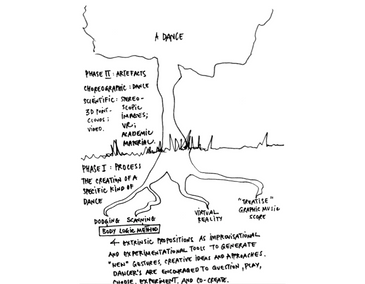
“Dance in Virtual reality – deconstructing choreographic objects through expanded media" is an installation-gallery in VR that has resulted from the convergence between choreographer Sylvia Rijmer's impulse to formalize her current compositional methodologies and the motivation of the BlackBox team to analyse and visually document unique artistic processes in contemporary dance.
BlackBox: Arts&Cognition/sylviarijmer
This VR Installation was created by the BlackBox team together with Sylvia Rijmer and the dancers (Teresa Alves da Silva, Allan Falieri, Elson Ferreira) to document the research around the Body Logic Method (BLM) using Kinect, 3D point-clouds, stereoscopic images, and audio-video.
Refer to p.33 from: Rijmer, S. (2022). Negotiating Deliberate Choice-Making: Insights from an interdisciplinary and multimodal encounter during the making of a New Contemporary Dance. In C. Fernandes, V. Evola, & C. Ribeiro (Eds.), Dance Data, Cognition, and Multimodal Communication (pp. 15-37). Routledge. https://doi.org/10.4324/9781003106401-3
Development: Rafael Kuffner, Cláudia Ribeiro, Stephan Jürgens and Francisco Henriques
Technical assistance: Sara Ribeiro
Artistic consultancy: Sylvia Rijmer
Direction: Carla Fernandes
Researched and constructed in collaboration with the BlackBox Arts & Cognition Project, Nova University, FCSH-UNL
© 2014–2019 BlackBox - Arts & Cognition | Legal Info | Privacy Policy | DfH
Lisbon, 201
Lisbon, 2019